
Character becomes an economic quality
For most of the history of professional services, scale meant people. AI is beginning to weaken that relationship as procedural logic is compressed, making human judgement and character the ultimate economic bottlenecks.


For most of the history of professional services, scale meant people.
A larger law firm could process more cases. A larger consultancy could conduct more research. A larger agency could produce more campaigns. Growth in output usually required growth in headcount because knowledge work was constrained by human attention.
AI is beginning to weaken that relationship
Google’s introduction of Gemini Enterprise for Legal is a useful step. The system goes beyond answering questions. It supports legal research, contract review, regulatory monitoring and other workflows, while connecting agents to the enterprise systems lawyers already use. Google explicitly frames this as a move from passive querying towards agentic execution.
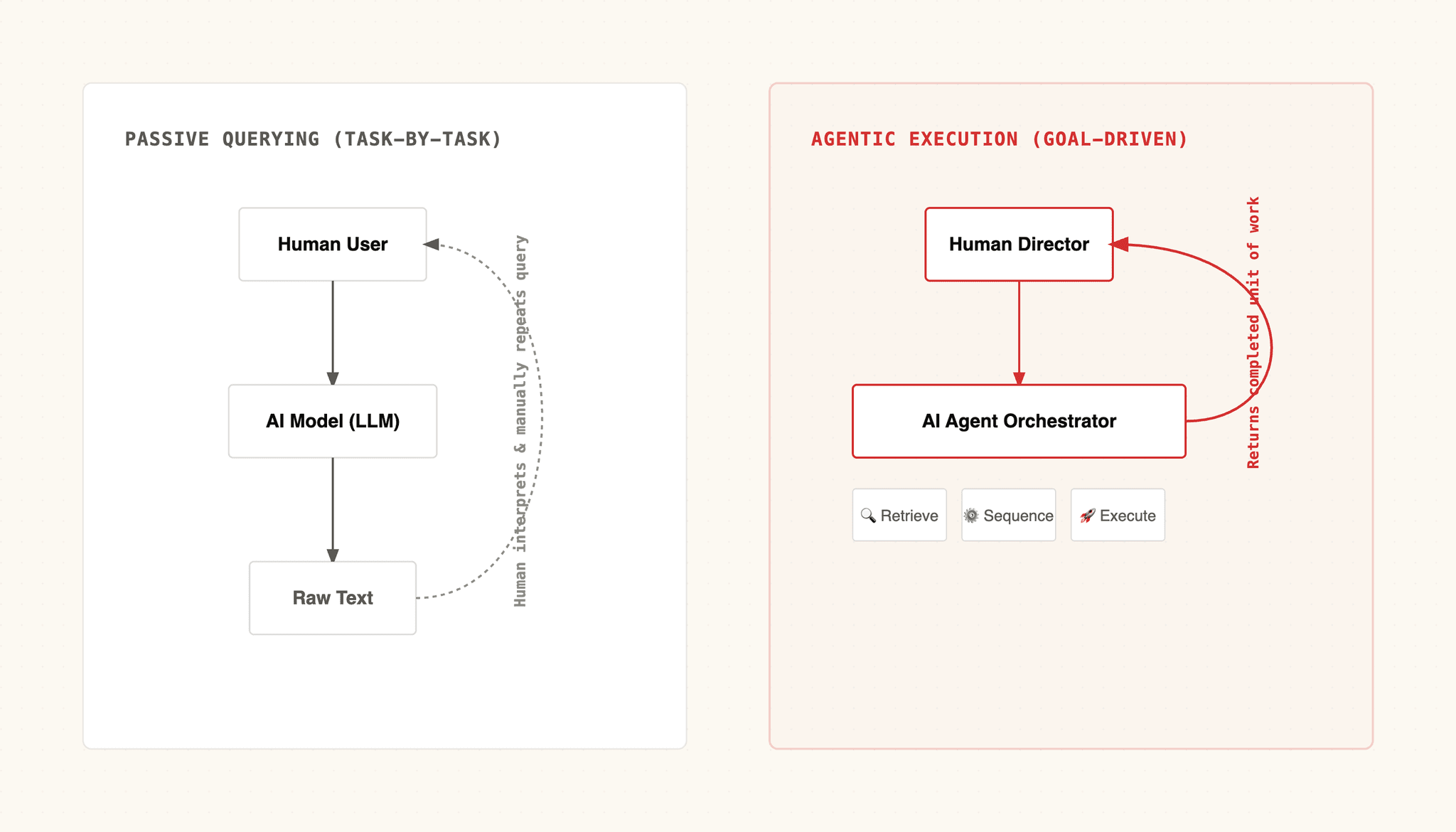
An assistant helps someone perform a task. An agent can increasingly retrieve the context, apply instructions, interact with systems and complete a sequence of actions.
This changes the organisational mathematics of knowledge work.
The productivity unit is changing
Professional organisations have traditionally decomposed complex problems across people. One person researches, another analyses, another prepares, another reviews.
AI compresses that chain.
Research becomes faster. Documents can be compared at scale. Meetings become structured knowledge. First drafts appear instantly. Agents can monitor information continuously and initiate the next step.
The amount of human coordination required to produce intellectual work starts to fall.
Research with 758 Boston Consulting Group (BCG) consultants offers an early indication. For tasks within AI’s capability frontier, people using GPT-4 worked more than 25% faster and produced work rated more than 40% higher in quality. Harvard researchers described the uneven boundary of these capabilities as the jagged technological frontier.
Higher quality output for consultants using AI within the capability frontier.
Source: Harvard Business School & Boston Consulting Group
A later experiment involving 776 professionals at Procter & Gamble found something even more consequential: individuals using AI could reach performance comparable to teams working without AI. The NBER study also found that AI helped people work across traditional functional boundaries.
The productivity unit of the future may increasingly be the individual surrounded by machines.
Smaller teams, higher expectations
It is tempting to turn this into a simple headcount story. That misses the more interesting shift. Current evidence still suggests that companies mostly use AI to augment work rather than eliminate jobs. The NBER study The Microstructure of AI Diffusion makes that clear.
But augmentation changes what remains for humans to do.
If an analyst previously spent six hours gathering information and two hours interpreting it, AI may reduce the first six hours dramatically. The remaining two hours then become the centre of the job. And those are often the harder hours.
The Hard Questions Behind Augmentation
• What does this actually mean? • Which assumption is wrong? • What are we missing? • When is the model confidently incorrect? • What should we do? • Who takes responsibility?
Removing routine cognitive work does not remove difficult decisions. It actually exposes them.
Judgement becomes the bottleneck
The BCG experiment also showed the danger of over-reliance. On one task outside GPT-4’s capability frontier, consultants using AI were 19 percentage points less likely to reach the correct conclusion.
That should influence how we think about talent.
“The valuable employee in an AI-intensive organisation cannot merely be someone who uses AI quickly. They need enough understanding to know when not to trust it.”
That requires judgement: the ability to frame the problem, challenge assumptions, recognise uncertainty, understand second-order consequences and distinguish an elegant answer from a useful one.
As machines take over more procedural logic, human value moves towards interpretation. And eventually, towards decision.
Character becomes an economic quality
This is where character enters the equation.
In large organisations, responsibility can be distributed across teams, layers and procedures. Smaller AI-enabled teams concentrate it.
If five people and a collection of agents can accomplish work that previously required twenty people, the judgement of those five people matters far more.
Gemini Enterprise for Legal is a useful early example. As research, contract analysis, regulatory monitoring and other structured reasoning become increasingly agentic, less human capacity is required to process the work. More human judgement is required to direct it.
You want people who can disagree intelligently. People who remain curious when an answer appears obvious. People who can defend an unconventional hypothesis. People willing to stop a process because something feels inconsistent with reality, even when the logic appears perfectly coherent.
These qualities are difficult to automate and difficult to measure.
For decades, companies selected knowledge workers partly on their ability to perform intellectual procedures: analyse this case, write this document, calculate this model, prepare this presentation. AI is becoming very capable at exactly those activities.
Organisations will therefore have to become better at identifying what sits underneath them:
- How does someone think?
- What do they notice?
- What do they question?
- Can they change their mind?
- Can they take responsibility?
- Do they have character?
A different kind of scale
Large organisations will not disappear. Many problems still require capital, infrastructure, distribution and coordination.
But their internal architecture can change.
A smaller group can command far greater cognitive resources. Specialists can operate across functions. Senior people can remain closer to execution. Computational capacity can scale without equivalent managerial complexity.
Companies used to scale intelligence by hiring intelligent people.
Increasingly, they will be able to scale intelligence computationally. That raises the standard for the people who remain close to consequential decisions.
Being intelligent will still matter. But intelligence itself becomes less differentiating when everyone has access to increasingly capable machine intelligence. What matters more is the ability to frame the right problem, test assumptions, recognise uncertainty and decide when the available evidence is insufficient.
Curiosity becomes a way of finding questions the system has not been asked. Judgement becomes the ability to distinguish a plausible answer from a consequential one. Accountability remains irreducibly human.
The result may be organisations with fewer people in the loop, but much higher expectations of each individual who remains there.
Smaller teams, higher expectations.
How will AI reshape your organization?
If you are interested in discovering how AI will change your business and how to elevate your team’s strategic impact, let’s compare notes.